

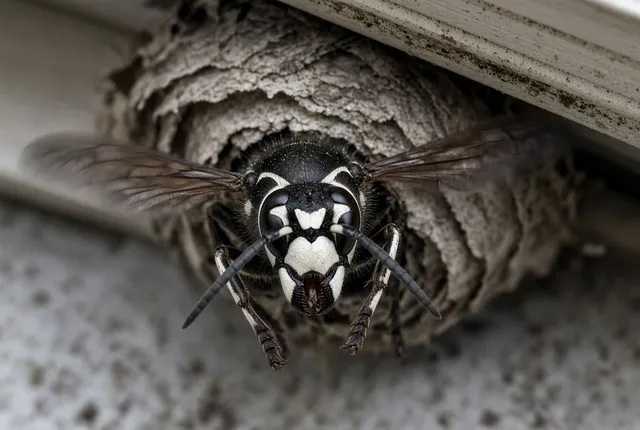
Identify wasps and hornets
Yellowjackets
Small and boldly banded in yellow and black. Some build enclosed paper nests in the open, while ground yellowjackets nest in soil or inside wall voids, which makes the entrance easy to step on.
Bald-faced hornets
Mostly black with ivory markings. They build large gray paper nests, often shaped like a football, on eaves, branches, and utility poles, and they guard them hard.
Paper wasps
Slender, with long dangling legs. Their open, umbrella-shaped nests hang under railings, eaves, and porch ceilings.
Signs you have wasps and hornets
- A gray paper nest hanging from an eave, branch, or shed
- Insects flying in and out of one spot in a wall or the lawn
- Buzzing from inside a wall or soffit
- A sudden rise in wasps around trash cans in late summer
Why they come inside
A lone queen picks a sheltered spot in spring, and the colony grows all summer. Sheltered corners, soffit gaps, and quiet corners of sheds all suit her, and colonies peak just as people spend the most time outside.
How Go Go treats them
We identify what is nesting and how reachable it is, then treat and remove the nest when conditions allow. We also look at the surrounding structure so the same spot does not host a new colony.
Covered by a protection plan?
Yes. Stinging insects are on the plan, so scheduled visits can find early-season nests while they are still small. See how plans work →
Wasp and hornet removal service page →
FAQ
Wasps & Hornets: common questions
How do I know if it is a hornet or a wasp?
Bald-faced hornets are mostly black and white and build the large enclosed nests. Paper wasps build open combs, and yellowjackets are small and yellow-banded.
Should I knock a nest down?
No. A disturbed colony defends itself aggressively, and a fallen nest still holds stinging insects.
Does the nest get reused next year?
No, the colony dies off in cold weather. New queens tend to look for similar sheltered spots, though.