

Identify bees
Carpenter bees
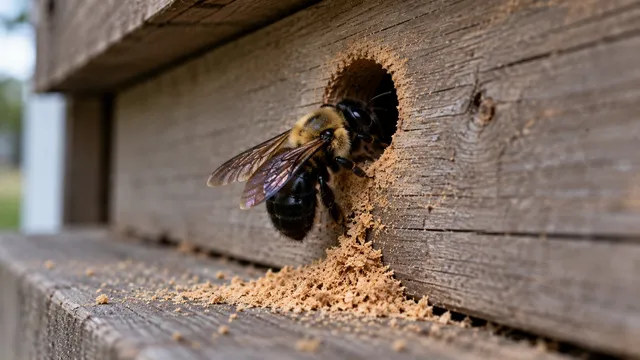
Large and rounded, with a shiny black abdomen. They bore neat round holes about the width of a finger into unpainted or weathered wood, such as decks, fascia, and railings.
Bumble bees
Fuzzy and black and yellow. They nest in small colonies in the ground, in grass tufts, or in old rodent burrows.
Honey bees
Smaller and golden-brown, living in large colonies. A colony in a wall or chimney leaves a steady stream of bees at one entrance.
Signs you have bees
- Perfectly round holes in wood with coarse sawdust below
- Yellow-brown staining on boards under the holes
- A steady line of bees entering a single crack in a wall
- A cluster of bees hanging from a branch or ledge
Why they come inside
Bees look for sheltered cavities and soft wood in spring. Bare decks and fascia attract carpenter bees, while gaps in siding and chimneys offer space to a honey bee swarm.
How Go Go treats them
Tell us what you are seeing and send a photo if you can. We start with an inspection and an identification, and what happens next depends on which bee it is and where it has settled.
Covered by a protection plan?
Yes. Bees are on the plan, so the inspections that look for nests can also catch early carpenter bee activity. See how plans work →
FAQ
Bees: common questions
Are carpenter bees dangerous?
Males hover and may seem aggressive, but they cannot sting. Females can, though they rarely do. The main concern is damage to wood.
Why are my deck boards full of holes?
Carpenter bees prefer bare, weathered softwood. Painted or sealed wood is less appealing to them.
I think I have honey bees in my wall. Who do I call?
Call us with what you see. Honey bees are valuable pollinators, so identification is the first step before options are discussed.